• A Corrupting Culture

    I don’t believe ACAB. But I understand how anyone who has repeatedly witnessed or been victimized by the actions of corrupt cops would.

    And let’s be clear: The “few bad apples” assessment is bullshit. The problem isn’t a handful of rogue individuals responsible for isolated incidents. The issues are institutional and systemic.

    You take an average human being and place them into a fiercely loyal fellowship that has an us-verses-the-world mentality. You put those people in harm’s way and expose them to the worst of human behavior, then give them a combination of power and impunity no individual should possess. You bolster them with the nation’s strongest unions and the support of wide swaths of the population who have been programed to believe cops are demigods who can do no wrong. Sprinkle their ranks with some authoritarians and hotheads and chip-on-the-shoulder types.

    Now what have you created? Who is that recruit now and what kind of officer are they? There is a word for groups that do to their members what the police community does: They’re called cults.

    Perhaps one reason I hate the “bad apples” metaphor so much is that it’s backwards. The full proverb is: One bad apple spoils the barrel. When it comes to the police, I believe the barrel rots the apples.

  • My Predictions for 2026

    Yes, they are a little bleak. These aren’t my hopes or wishes. Just how I think the upcoming year will play out. And if I get half of these right, I expect to be hailed as a most perspicacious profit.

    • There will not be a big Blue Wave. Democrats will win back the House with a thin majority, but not the Senate.
    • There will be a major U.S. stock correction that will cause shockwaves throughout world markets.
    • The rate of inflation will break 3.5%. and the unemployment rate will grow to 5.5%-6%.
    • The war Ukraine will not end.
    • Measles infections will skyrocket to 10K+, with Texas, New Mexico, and Utah among the hardest hit.
    • A new variant of COVID will emerge but not be properly identified as such until a large outbreak results in “grassroots” research.
    • There will be at least one major white nationalist-inspired event involving multiple fatalities.
    • There is a 90% chance Israel will resume hostilities in Gaza and Netanyahu will use the pretext of keeping Israel safe as the foundation of his re-election campaign.
    • There is a two-in-three chance China will militarily intervene in Taiwan, ousting the regional government and asserting control. This will be met with violent resistance.
    • Donald Trump’s physical and mental health will continue to deteriorate. His actions will grow increasingly erratic, and his inner circle will be caught off guard. There is a 50% chance his presidency will end. Although there will be an effort to invoke the 25th amendment, this will likely fail. Trump will not leave office willingly, so if his tenure ends it will likely be due to physical incapacitation or death.
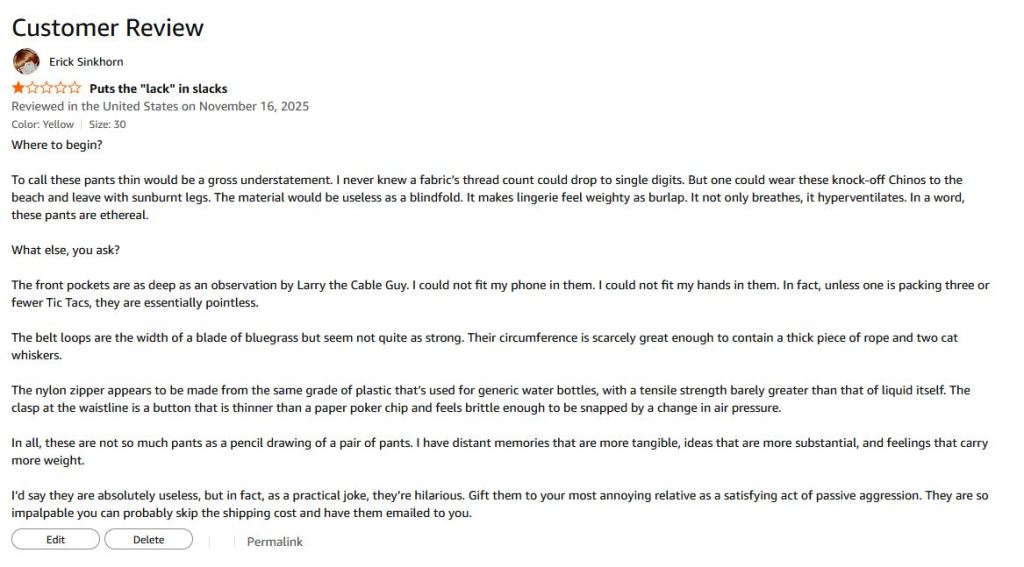
  • I’ve never felt compelled to write an Amazon review of anything. Until now.

  • If you really want the world to know how banal and unimaginative you are, please post more slop.

    Start by replacing a word in some common term or cliché with an inelegant near-rhyme befitting a drunk toddler. Then throw that drivel into your nearest AI garbage maker and crap it out into the vapid ethersphere of social media.

    Voilà! Now you can pretend you are clever, creative, and witty, just like the talented people who spend years honing their knowledge and skills to craft meaningful original content.

  • “Uncertainty is the only certainty there is, and knowing how to live with insecurity is the only security.”– John Allen Paulos, professor of mathematics, Temple University

    Change is inevitable.

    Sometimes, we initiate it, with intention and agency. Often, however, it is foist upon us by circumstances beyond our control. And with that sort of change comes the unknown. What lies at the end of this new road? What will tomorrow bring? Our minds race to fill in the gaps with something we can grab hold of. It can feel like stepping off a precipice, not knowing if or where your foot will land next.

    You may be feeling anxious just reading those words. That’s because uncertainty is anathema to human beings. We, who want to plan, organize, prepare, and—most of all—control. We feel destabilized when the universe throws us a curveball. And our first impulses are not always the most helpful. Do we try to fight the change? Or ignore it and pretend it won’t happen? Do we attempt to game out every possible outcome, perhaps focusing on the worst-case scenarios as a way to “prepare”? Or maybe we self-soothe to counter the discomfort, but choose unhealthy behaviors to distract us?

    Navigating change and the uncertainty it brings can be difficult and frightening. There is good news, though: We don’t have to do it alone. And there are things you can do – tangible, tried-and-true ways of processing such times in life that will keep you balanced, resilient, and more confident when you move into uncharted territory.

    Don’t resist

    It’s helpful to begin processing a change by acknowledging how you feel about it. Are you anxious, worried, confused, angry? There are no wrong answers – only inauthentic ones. In other words, be honest with yourself. Try writing things down or talking about them with someone you trust. This may help solidify and validate them for you. The change is real; so are your feelings. Don’t deny the existence of either.

    Fighting unavoidable change is useless. It will only tap your energy reserves and create greater distress. Instead, learn to accept the new reality so that you can adapt to it. Bruce Lee often spoke of the “stiffest tree,” which cracked when struck by the unrelenting force of the wind. It is the flexible reed grass, bending and bowing in the gale, that knows how to weather the storm and survive. When we practice acceptance and acknowledge what we cannot control, we begin to see more clearly what we can.

    Focus on what you can control

    Now, lean into the things that are within your control, whatever they may be. Perhaps these are related to the change; small things you can prepare and lean in. But more likely, they are the other parts of your life over which you have some agency. Plan your meals, follow your exercise routine, schedule your time and activity in ways that are consistent and dependable.

    There are so many things over which we have no influence. A change in health, the loss of a job, the actions of corporations and governments. All these things impact us, yet as individuals, we are powerless to control them. We can, however, determine how we respond to them. And we can control the other parts of our lives to foster a sense of stability and structure.

    Don’t believe everything you think

    In uncertain times, it’s important not to assume the worst-case scenario is inevitable. We may tell ourselves that we’re merely preparing ourselves emotionally for whatever transpires. But this tendency is nothing more than a self-defeating source of unnecessary anxiety.

    When we don’t know what to expect, our brains can trick us into thinking that fears and feelings are facts. We grieve for what we haven’t truly lost and react to things that haven’t yet happened. This negativity bias can create a self-fulfilling prophecy. If we expect the worst, we get tunnel vision and may miss the options and opportunities that are right in front of us. Rather than pre-limiting your destiny, remember that every unknown future is a Schrödinger’s cat, and all possibilities are on the table until proven otherwise.

    Use past successes as your guide

    It’s true that every situation is at least a little bit different. However, most of the challenges we face bear some similarity to a previous experience. And the greatest, most powerful thing they have in common is you. You have faced obstacles and breached the unknown before, and you came out on the other side. While exactly what you are confronting today may be an unknown, your past successes are a matter of fact. They are immutable touchstones from which you can learn.

    Reflect on how you’ve previously navigated uncertain times over the years. What did you do that was helpful then? What would you like to do differently this time? There are always lessons to be gleaned from our experiences. But the biggest one may just be that fact that you successfully rose to and surmounted your challenge. You have a track record. You have skills and abilities, and a depth of resilience and a strength of mind that you may not even be aware of. You can’t deny it, because there is proof. Hold fast to that bit of self-awareness and let it reinforce your confidence to do what you’ve always done before.

    Try to stay in the present

    Having noted the importance of recalling your former successes, it is equally vital to avoid hanging around in bygone days for too long. I have spent an inordinate amount of time in my life doing what I call “time travelling.” I’ll find my mind is not rooted in the here-and-now but rather ruminating over the past or dreading the future. And this tendency can really burst into overdrive when I’m dealing with an unknown.

    But fixating on yesterday’s “failures” is as self-defeating as it is reductive. It serves no purpose but to make one fret. And attempting to predict tomorrow’s defeats is equally pointless, not to mention literally impossible (see the Schrödinger’s cat reference above). All that exists is now and you can only do your best with what you have today.

    So, draw yourself out of your head and be present in the time and place around you. Relaxation, mindfulness, or getting outside to enjoy nature are all excellent ways to ground yourself in what is real. Focus on your breathing and cultivate a sense of calm. It will center you and re-energize you for whatever lies ahead.

    Engage in healthy comforts

    And speaking of staying energized…

    It often seems like the times we most need to rely on the simple joys in life are exactly when we allow those healthy pleasures to fall by the wayside.

    Don’t let stress derail your physical routines. Make an effort to eat well, exercise, and get plenty of sleep. Mind and body are two sides of the same coin, and you cannot neglect one without it impacting the other.

    Also, nurture yourself. Be kind to yourself. Even spoil yourself in times of stress. At first, you may feel like it’s almost inappropriate to enjoy your life while the 800lb gorilla of uncertainty is knocking at your door. But self-care isn’t a mere lark. You need it to recharge your battery. So, continue to do what you love so that you may preserve your balance, maintain your perspective, and fortify your mood.

    Seek support

    Finally, and most importantly, none of us must go through times of change and uncertainty alone.

    Many people isolate themselves when they feel anxious, sad, or worried. But humans are social beings and require support from one another to stay healthy and happy. So, reach out to your family and your friends. Let them know how you’re feeling and talk through your thoughts and concerns. Also, consider speaking with your doctor or a mental health professional. They have insights and tools you may have never considered.

    The Greek philosopher Heraclitus said, “Change is the only constant in life.” That being true, we are best served by accepting it and learning how to incorporate whatever it brings into our lives in the smartest, healthiest way we can. We may not know what the future holds, but if we know ourselves and our needs, we can have the confidence to face and adapt to anything.  

    Additional resources:

    How to deal with change and uncertainty, The National Health Service—UK

    How to deal with uncertainty: 8 ways to cope in uncertain times, Calm.com

    10 tips for dealing with the stress of uncertainty, American Psychological Association

  • Thoughts in the Dark

    I can’t sleep.

    I can’t, because when I close my eyes, my defenses drop. The distractions cease, the denial fades, and I’m gripped by the horrifying realization of just how fucking crazy it all is. How impossible. How… surreal.

    Sometimes I feel like I’m the one who has gone crazy, not this country or more than half of the people in it.

    There was a 𝘤𝘰𝘶𝘱. A real-life fucking coup against the government of the United States, and it was incited by the President. He told people to riot and take control of the Capitol, and they did! The goddamned President got people to violently storm the seat of American government. And they sought out the Vice President and would likely have killed him had they found him. And people died. And when the revolt was finally put down, the President… was still in power! He told the mob that he loved them, then he served out the final days of his presidency, and went on with his life. He was not immediately arrested and tried for treason. We just let him walk away.

    Then, as if that weren’t the wildest shit you’d ever heard in your life, he actually became more popular. This human antithesis of American democracy and the greatest threat to the Union since the Civil War consolidated more power, duped more people, inspired more rage, told more lies — crazy lies, obvious lies, lies that any child could see through, lies like some paranoid street person would scream — and ran for president again.

    And won.

    This madman shit on it all. The Constitution. Veterans. Voting rights. Separation of powers. The rule of law. All the things Americans say are their highest ideals and most sacred principles. And they… they didn’t care. They didn’t give two flying fucks about any of it. Which is crazy to me, because as a liberal, do you know how many times I’ve been told by rabid God-and-Country flag-wavers that I am “anti-American”? But then those people, those very people, chose a demagogue, a cult leader, a violent strongman over every single thing America is allegedly about.

    In another time, this man would have been drug away in shackles. In another time — and I’m not saying this is right — but this man may not have lived to see his day in court. And those under his direction and control would have spent decades in federal prison, at the least.

    Instead, he made it all the way back to country’s top post, like some third-rate South American dictator or ruthless tribal war lord. And now we’re talking about, what? Tariffs? The board of the Kennedy Center? The fate of the penny?

    HE TRIED TO OVERTHROW THE FUCKING GOVERNMENT AND HAVE HIS VICE PRESIDENT ASSASSINATED. THIS IS NOT BUSINESS AS USUAL.

    I know you know all this. We all know all this. We go on because we have to. Because we can’t do anything else. I think. Maybe. Or maybe we don’t even want to consider what other people in other countries under similar circumstances have done. Those things are alien to us and our lives. We wouldn’t know where to begin. (Or worse, perhaps–where to stop). So, we cross our fingers and hope that somehow things will work themselves out.

    Anyway, that’s why I can’t sleep.

    And as I read over what I’ve written here tonight, I think, My god, no wonder I questioned my own sanity: This sounds like the ravings of a lunatic. The rant of a man who has had a psychotic break and is experiencing apocalyptic-level delusions. This man needs help.

    Yeah. In some ways, I guess I do. But I also realize that this is sanest thing I’ve thought or said in a long time. And one of the truest. It’s the rest of the time that I’m pretending, ignoring, distracting myself, living in a fantasy. And I hate that I do it, but I know I have to. To preserve my sanity. To keep intact the part of me that sees all too clearly what is real. That fact is, for the few minutes it took for me to write these words, I’ve never been in greater possession of my faculties. And that’s what scares the ever-living shit out of me.

  • Ode to Laurie Anderson

    What I love are ideas.

    Thick, rich, meaty ideas that envelope and consume me. Ideas into which I can disappear.

    Expansive ideas that spill out and flow through other ideas; not so much interconnecting as intertwining, interweaving, breathing in tandem as a nascent life.

    Sometimes, these unions manifest as puzzles, with distinct elements that join in startling ways to reveal the unseen.

    Other times, they present as hearty broths whose ingredients dissolve and recombine to form something wholly new and unique.

    These ideas do not sit inert on a shelf; they live as evolving narratives. They are stories. And stories about stories.

    They course through history, unbound by time, racing anagrammatically up and down the ages—future and past, now and always.

    These ideas that I love surge in the veins of the cosmos and nourish the mind of creation.

    They are too great to be contained, and yet they are written into every cell, every atom of existence.

    Someday, I will give myself over to them. Not just my time and thoughts and moods, but all that I am. All I am borrowing from the universe to sustain this temporary, fractured artifact will be reabsorbed, and I myself will become but an idea.

    For now, however, I will continue this courtship. Tantalizing obsession, exhilarating vocation, quintessential pursuit.

    I chase what I love. What I love are ideas.

  • Tripping the Breaker

    I once read that the best way to kill a fly is to come at it from two directions at once. Flies have very small brains and can’t process a lot of simultaneous information. When presented with too much and/or conflicting data, its primitive nervous system overloads and momentarily freezes. This also reminds me of a computer that is tasked with more concurrent operations than its memory can process.

    And this is what it’s like to have anxiety and ADHD. A low-grade anxiety can be like an invisible background app. It doesn’t burn up a lot of resources, but it is constantly running below the surface, syphoning one’s reserves. Then, when you fully engage in a world full of stimuli, the ADHD kicks in. Suddenly, you lose the ability to prioritize or filter what is thrown at you and your brain wants to absorb and process everything all at once. You attempt to call in reinforcement, but thanks to anxiety, the back-up tank is empty. So, bam! The whole machine grinds to a halt. Your mind’s circuit breaker has just been flipped, and you are paralyzed.

    Like the proverbial fly, the overtaxed PC, the deer in the headlights, or any other metaphor you choose to use, you’ve been effectively immobilized. To put it more bluntly, you can neither shit nor get off the pot. Cue the period of dissociative fugue: The zombie time of aimless, quasi-consciousness that steals the hours and extinguishes focus and motivation. Eventually, you awake from this hazy state to confront the disappointment and shame that await you on the other side.

    And this is how, to borrow from the Bard, “The native hue of resolution is sickled o’er with the pale cast of thought, and enterprises of great pith and moment… lose the name of action.”

  • Thunder Enlightening

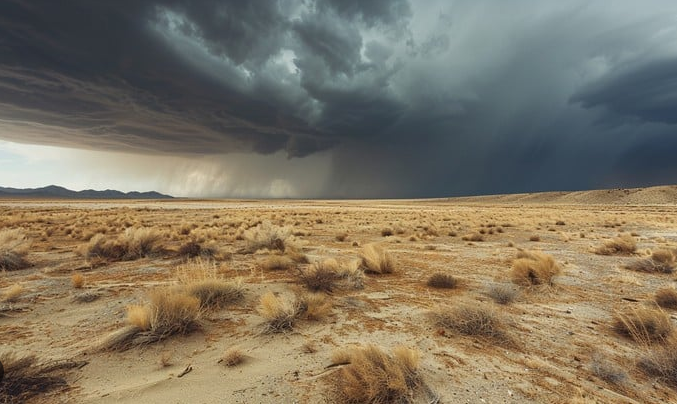
    Rain has come to break this pernicious spell and disperse the hazy swelter we’ve worn like a hairshirt for weeks on end. Heavy and dense is the morning canopy that shields us from the vengeful sun. Even a brief reprieve is welcomed. A moment to breathe. A rejuvenating respite.

    I love the rain. For reasons I could talk about all day. But right now, with the deep rumbling thunder still echoing in my ears, I’m thinking of “The Wasteland”. T.S. Eliot’s epic poem—a spiritual reflection on 1920s post-war ennui—feels like a chronicle of our own age. It’s every bit as prescient as Yeats’ “The Second Coming”, yet more visceral and unsettling.

    The part of the poem that resonates with me the most (no pun intended?) is ‘What the Thunder Said’. In this final section, Eliot repeatedly uses the brash, monosyllabic word “DA” to elicit a sharp, sudden clap of thunder. This sound also evokes three Sanskrit words that draw together his closing argument.

    Datta, dayadhvam, damyata—an instruction delivered in a Hindu Upanishad—mean give, sympathize, and control. It was the guidance imparted to Devas by Lord Brahma as the way to avoid war and achieve lasting peace. Eliot uses the words to onomatopoeiatically represent a grim warning from a grumbling sky.

    As each command crashes down from the heavens, the author considers how his world has betrayed it. Little is freely given, he posits. Human relationships have become transactional and self-serving. Sympathy for others is illusive, as we have each isolated ourselves behind defensive ramparts, encasing ourselves in fortifications that double as prisons. And our control, referring to self-control, has eroded. Our “hearts would have responded.. to controlling hands” had we allowed them to. The waters were calm, but we were not.

    When I hear the growing rolls of thunder that herald an impending storm, I often reflect on “The Wasteland”. I think of how the poem ends before the first raindrop falls. How the scorched, dying earth continues to ache for the cleansing deluge that waits on the horizon. The rain is not inevitable. The salvation of its baptism can only be realized when we recommit to the sacred precepts its roaring voice bellows over the land.

    A reminder. An enticement. A warning. A promise. The thunder is all these things to me, thanks to Eliot. This morning, I am listening to the sky. Its message is crisp and unmistakable.

    Datta. Dayadhvam. Damyata.

    Give, sympathize, control.